How gut testing and retesting helped one family understand their twins’ colic, reflux and food sensitivities
Written by: Alba Health team
Last updated: 2026-03-20

Summary
Colic, reflux, and early food sensitivities are often difficult to explain. This article explores how one family used gut microbiome testing and follow-up analysis to identify imbalances, track changes over time, and take targeted steps to support their twins’ gut health.
In this article
A difficult start: Prematurity, tubes and colic
Searching for answers
What the first gut test revealed
The breakthrough: Three days to a smile
The second test: A major shift in their gut microbiome
Why twins can have completely different microbiomes
From survival mode to food discovery
What Jonas wants other parents to know
Key takeaways
For Jonas, living in central Copenhagen, the arrival of his twins was a hard-won victory.
After surviving cancer twice – including a demanding bone marrow transplant – becoming a father wasn’t something he ever took for granted.
Despite skepticism about whether fatherhood would even be possible after such intensive treatments, Jonas and his wife, who works in the wellness industry, decided to try.
To their surprise and joy, they discovered they were expecting twins.
“Our story isn’t really about illness,” Jonas says. “It’s about life, love, and expanding.”
But their start as parents quickly became far more difficult than they expected.
A difficult start: Prematurity, tubes and colic
The twins were born via C-section at 36 weeks. Their daughter, Olympia, weighed only 1.5 kg and required breathing support and tube feeding during the first weeks of life. Her brother Miles weighed 2.5 kg, but soon developed significant reflux.
The hospital stay was emotionally demanding.
“They were hurting. Seeing my daughter cry when they put the needle in… that was tough.”
Once home, the family faced months of colic and digestive discomfort. Olympia cried almost constantly for three months, while Miles struggled with reflux. The exhaustion quickly took its toll.
“It felt like putting a bandage on an open wound,” Jonas says. “It didn’t fix the underlying issue.The exhaustion was robbing me of the fatherhood experience I had fought so hard to stay alive for.”
Jonas felt that the advice they received from healthcare professionals offered little explanation for what was happening.
“Doctors and nurses said things, but there were no real solutions.”
Searching for answers: “I needed the biological truth”
Because the twins were born by C-section and experienced early medical interventions, Jonas suspected their gut microbiome might have been affected.
He began researching and eventually discovered Alba Health’s microbiome testing. The results gave him something he had been missing: a biological explanation.
“It was very nice to see that – okay, there’s actually something biologically out of balance.”
What the first gut test revealed
The twins’ microbiome analysis revealed two important findings.
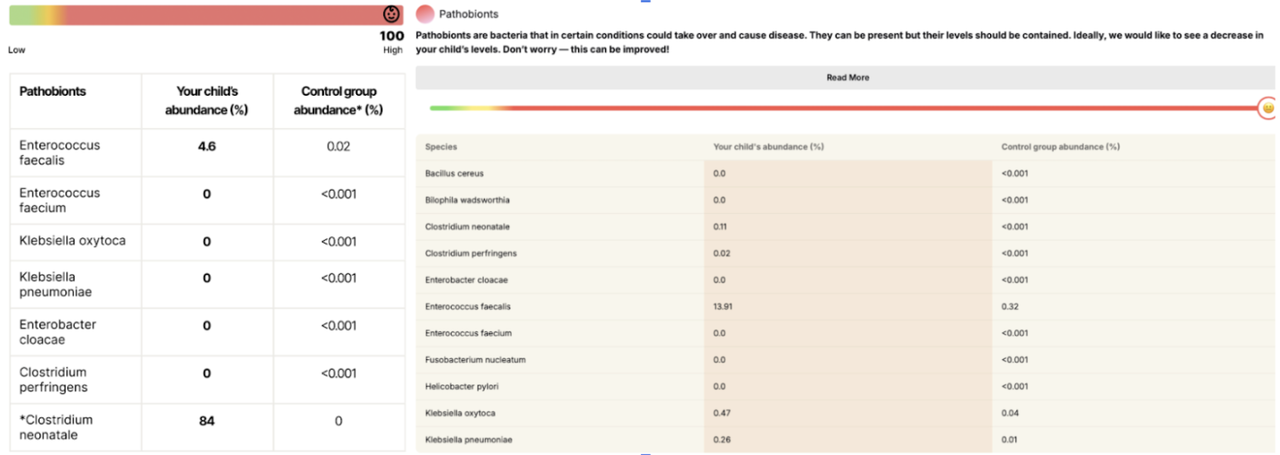
First, both twins showed very high levels of Clostridium neonatale, a “bad” bacterium often found in premature infants and associated with early gut instability.
Miles & Olympia test #1, Pathobionts:
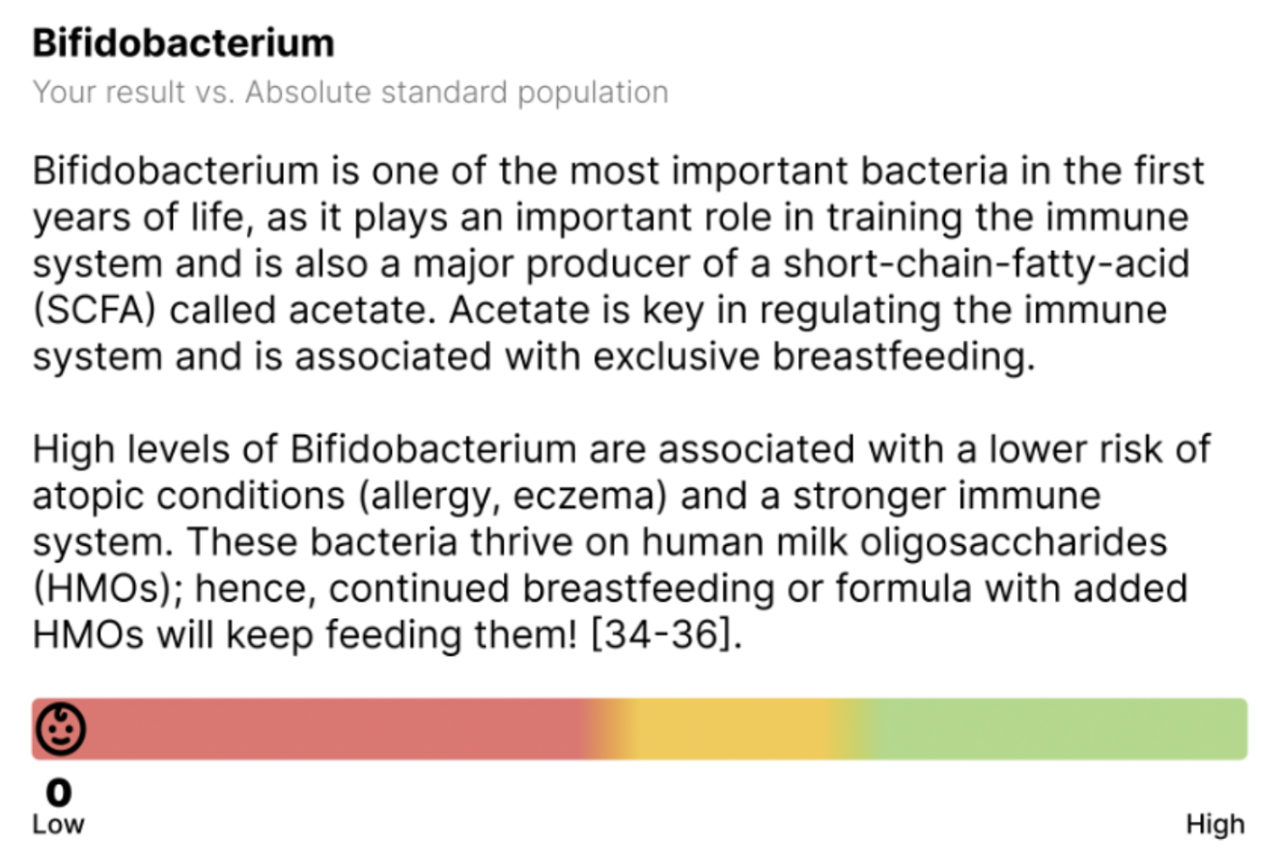
Second, they had low levels of beneficial Bifidobacteria, the bacteria that normally dominate the gut of healthy breastfed infants and help digest milk sugars while supporting immune development.
For Jonas, finally seeing the data was a relief.
“With Alba you get data on the gut and where it is today. That is gold.”
The breakthrough: Three days to a smile
Based on the test results, Alba recommended a strain-specific probiotic: Bifidobacterium infantis, a species known to help restore beneficial infant gut bacteria.
Both twins began taking the probiotic. The change was dramatic – especially for Olympia. Within just three to four days, she stopped crying and laughed for the first time.
“I cried because she had been crying for three months. She was in pain. Now my girl is shining.”
A relative who had previously remarked that Olympia was never happy was stunned by the transformation.
“Now she is very happy.”
The second test: A major shift in their gut microbiome
At eight months, Jonas performed a follow-up test to understand how the twins’ microbiomes were evolving as they began eating solid foods.
One of the most striking findings was the dramatic reduction of Clostridium neonatale. In their first samples, this bacterium made up around 84% of their gut microbiome.
By the follow-up test:
- Miles: 84% →0.05%
- Olympia: 84% →0.11%
Today, both twins show very low levels, indicating that their gut ecosystems have matured and developed stronger natural defenses.
But even though the twins share the same genetics and home environment, their gut microbiomes had developed in very different ways.
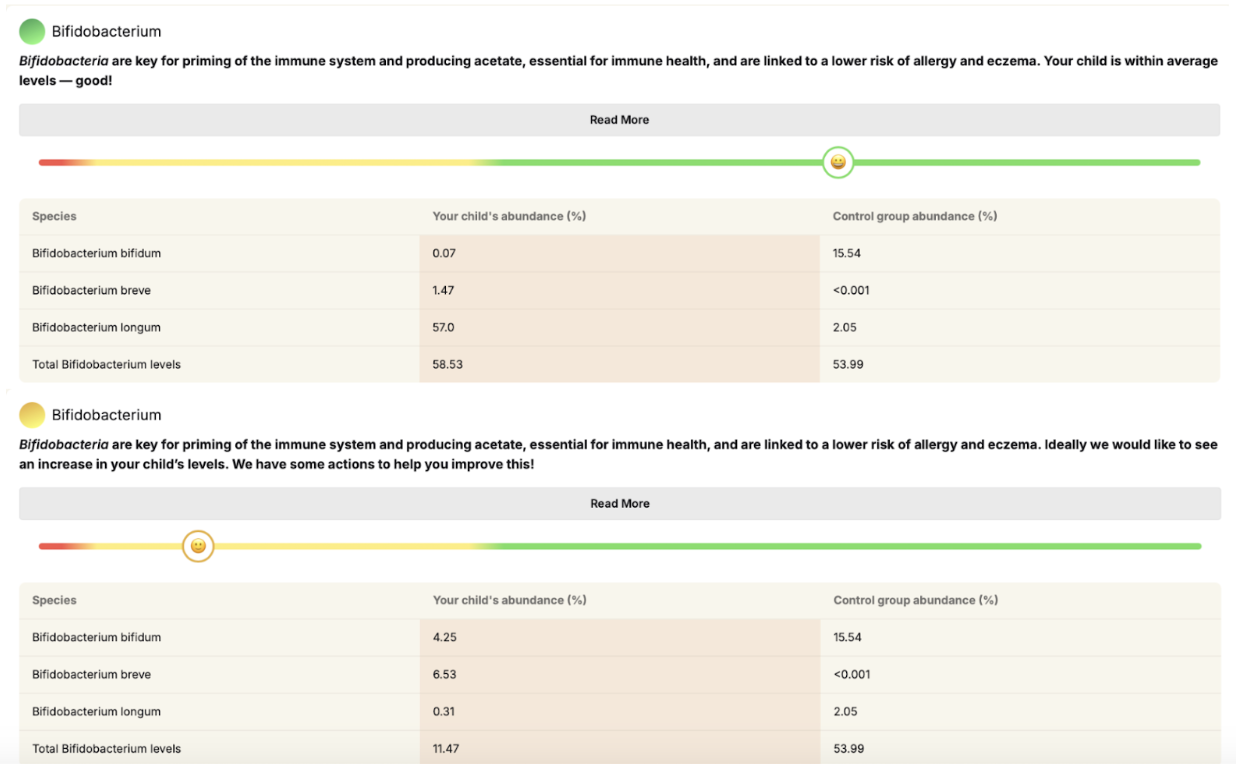
Another surprising finding from the twins’ follow-up test was that Miles had much lower levels of Bifidobacteria than Olympia, even though both twins had taken the same probiotic: Bifidobacterium infantis.
At eight months:
- Olympia: ~58% Bifidobacteria
- Miles: ~11% Bifidobacteria
The explanation lies in how different probiotic strains survive in the gut.
Olympia test #2 & Miles test #2, Bifidobacterium:
Bifidobacterium infantis is highly specialized – it feeds on HMOs (human milk oligosaccharides), the unique sugars found in breast milk.
Because Miles transitioned more quickly to solid foods like bananas and other fiber-rich foods, the “fuel” that supports B. infantis gradually disappeared from his diet.
As a result, his microbiome shifted toward bacteria that thrive on plant fibers.
To better match this new environment, Alba recommended switching Miles to Bifidobacterium breve M-16v, a strain that can grow on the fibers found in solid foods and help support the gut during this important dietary transition.
Why twins can have completely different microbiomes
One of the most interesting insights from the twins’ case is how different their gut ecosystems became.
Despite sharing:
• the same parents
• the same genetics
• the same home environment
their microbiomes evolved differently due to small differences in diet, feeding patterns, and developmental timing.
This highlights an important message:
There is no one-size-fits-all microbiome – even for twins.
From survival mode to food discovery
Today, the early months of stress have been replaced by curiosity and exploration.
Jonas now approaches food very differently. Instead of only offering purées, he encourages the twins to explore textures and whole foods, letting them hold and experience food with their senses.
“Food is the most important way to help them,” he says. “It’s a little mission for me – seeing how they react, letting them feel and explore.”
What Jonas wants other parents to know
For Jonas, the biggest change wasn’t just the improvement in symptoms. It was the understanding.
“It’s very human that when there is a lot of pain, you want a biological explanation.”
Testing gave him the clarity he needed to make informed decisions.
“I would never have known about the probiotics and specific strains if I hadn't tried Alba.”
Looking back, he believes the twins might have struggled much longer without it.
“I’ve talked to people who had colic for two years. We could probably have had the same story.”
Instead, the family moved from confusion to confidence – and from survival mode to joy.
Key insights from the twins’ gut tests
• Clostridium neonatale reduced dramatically: 84% → less than 0.1%
• Olympia developed a strong infant microbiome: ~60% Bifidobacteria
• Miles’ microbiome matured rapidly: 12 → 51 microbial species
• Probiotic strategy adapted to diet: B. infantis → B. breve
The takeaway
The twins’ journey highlights how dynamic the early gut microbiome can be.
Early disruptions such as C-section birth, prematurity, or medical interventions can influence gut development.
But with the right insight and targeted nutritional support, the microbiome can evolve and recover.
For Jonas, that knowledge changed everything.
“The coaching is so valuable because it’s tailored to your needs. I’m happy Alba has been a frontrunner in making this possible for people like me.”
Curious about your child’s unique gut patterns?
With Alba, you understand your child’s gut health – and get a clear plan to help their gut thrive.
Get started